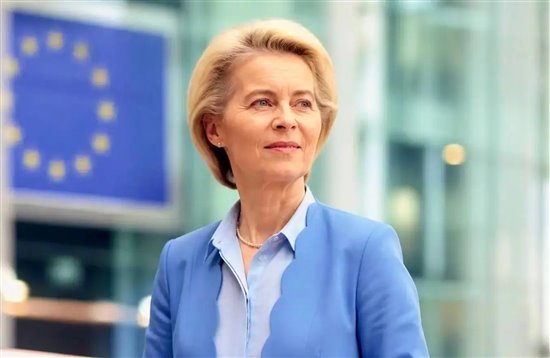
A photo of Ursula von der Leyen standing confidently in a modern European Union setting.
Ursula von der Leyen has emerged as one of the most influential women in modern global politics, leading the European Commission with a combination of resilience, strategic clarity, and historic significance.
As the first woman to hold this office, and recently re‑elected for a second term lasting until 2029, she stands at the center of Europe’s response to some of the most challenging events of the 21st century.
Her leadership reflects not only political experience but also a deep commitment to the idea of European unity at a time when global instability continues to reshape international relations.
Her path to power is remarkable. Trained as a physician, von der Leyen transitioned from medicine to politics, rising through Germany’s federal ministries before becoming the country’s first female Minister of Defense.
This unusual trajectory, from medical practice to high‑level political leadership, has contributed to her reputation as a disciplined, analytical, and determined figure.
Her long‑standing connection to the Christian Democratic Union and her alignment with former Chancellor Angela Merkel helped shape her political identity, but her influence today extends far beyond national borders.
Von der Leyen’s presidency has been defined by major policy initiatives that have reshaped the European Union’s priorities. The European Green Deal, one of her flagship projects, aims to make Europe climate‑neutral by 2050 and represents the most ambitious environmental transformation in EU history.
She also guided the Union through the COVID‑19 pandemic, coordinating vaccine procurement and cross‑border health strategies during a period of unprecedented uncertainty. Her leadership during Russia’s invasion of Ukraine further solidified her role as a central voice for European unity, sanctions, and long‑term security commitments.
Beyond crisis management, von der Leyen has become a leading advocate for digital regulation and online safety. She has repeatedly warned about the dangers posed by aggressive algorithms, disinformation, and the exploitation of children online, pushing for stronger digital protections across the EU.
Her speeches often emphasize that Europe must choose “Union” to face global challenges, a message that resonates strongly in an era marked by geopolitical fragmentation and rising authoritarianism.
Her defense of Greenland: A new front in European Sovereignty
In recent years, Greenland — a semi‑autonomous territory of Denmark — has become a geopolitical flashpoint due to repeated attempts by U.S. President Donald Trump to assert American control over the island. Von der Leyen responded with unmistakable clarity: Europe stands firmly with Greenland and Denmark.
During her 2026 visit to Nuuk, she announced a €200 million EU investment package to strengthen Greenland’s infrastructure, education, fisheries, renewable energy, satellite communications, and critical raw materials sectors. She declared that “Greenland can count on the EU”, reaffirming Europe’s commitment to the island’s sovereignty and future.
Her message was not only economic but deeply political. She emphasized that Greenland’s future belongs to the people of Greenland and Denmark — “no one else.” This stance directly countered Trump’s annexation threats and reinforced the EU’s role as a stabilizing force in the Arctic.
Von der Leyen’s defense of Greenland also included security cooperation. NATO’s Arctic Shield exercises, involving 10–11 allied nations, coincided with her visit, underscoring Europe’s readiness to protect the region’s strategic interests.
Her actions positioned Europe as a guardian of Arctic sovereignty, climate stability, and democratic partnership — a role that has elevated her global profile even further.
Inviting Canada to Join the European Union — A historic proposal
In her 2026 State of the Union address, von der Leyen made headlines by proposing that Canada become the first associate member of the European Union — a status that does not currently exist under EU treaties.
Standing alongside Canadian Prime Minister Mark Carney, she argued that Europe must “re‑imagine its partnerships” in a fractured global system. She highlighted the deep alignment between Europe and Canada on climate change, AI governance, Arctic security, democracy, and global trade.
Her proposal would elevate EU‑Canada relations to their highest level ever, creating new alliances in manufacturing, critical minerals, defense cooperation, and technology.
Von der Leyen stressed that this partnership was “not against anyone else, but for our common strength.” Her vision reflects a broader strategy: expanding Europe’s circle of democratic allies to reinforce stability in an era of rising geopolitical tension.
If realized, Canada’s associate membership would mark one of the most significant expansions of European influence in modern history — and it would be credited to von der Leyen’s bold diplomatic imagination.
A leader redefining Europe’s global role
Today, Ursula von der Leyen stands as a symbol of European resilience and ambition. She represents the EU at G7, G20, NATO summits, and major diplomatic negotiations, shaping Europe’s global posture with a firm and pragmatic approach.
Her leadership continues to influence debates on climate, security, digital governance, Arctic sovereignty, and the future of European integration.
Her defense of Greenland and her invitation to Canada signal a new era in European diplomacy, one defined by strategic alliances, democratic solidarity, and a clear assertion of Europe’s place in the world.
For many, she embodies the possibility of strong, principled leadership in a world where stability is increasingly difficult to maintain.
Ursula von der Leyen, EU–Canada partnership, Greenland EU relations, Arctic sovereignty Europe, European Green Deal, features, politics, EU geopolitical strategy, NATO Arctic security